
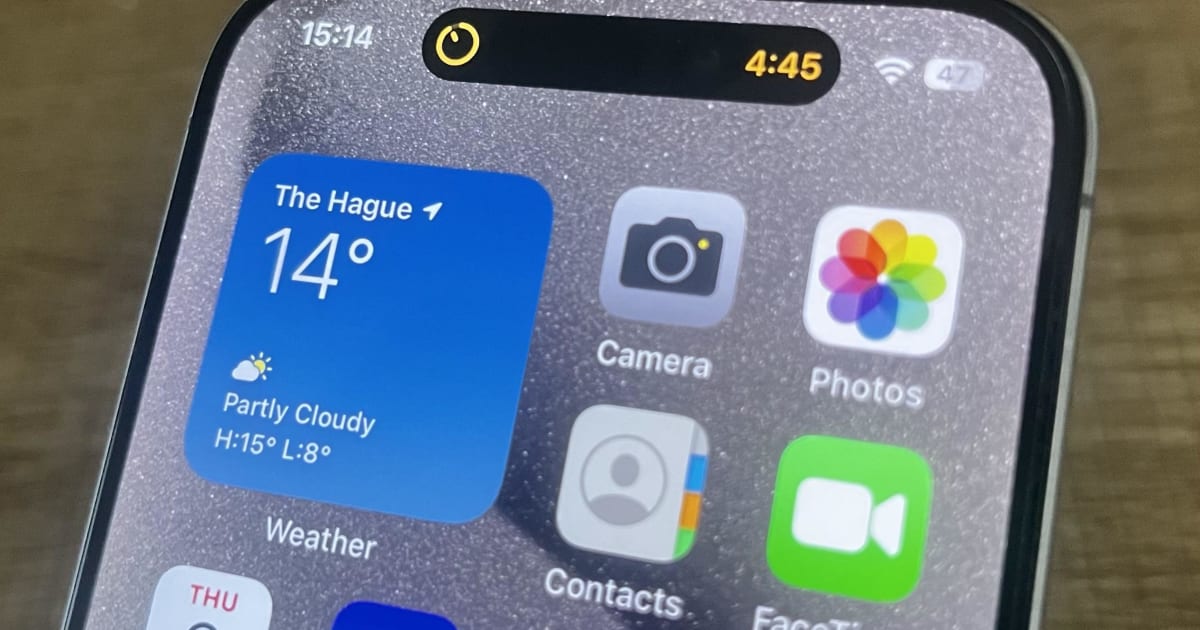
Until now, many of our current devices, from iPhones and Android phones to MacBooks, have had to rely on a large "notch" for facial recognition. However, this might be about to change with the introduction of Metalenz's Polar ID: a secure, simple, and even cheap method of facial recognition that "cuts down" on the cutout.
Metalenz is a semiconductor company with the goal of connecting humans and tech devices in new ways. Metalenz's use of AI and metasurfaces--very thin synthetic materials that are smaller than the wavelength of light--allow them to achieve this goal.
While this facial recognition technology will only be available for Android phones at first, it definitely seems plausible that this breakthrough innovation will eventually be incorporated into other devices, such as Apple's products. A major benefit of using metasurfaces is that they allow the Polar ID camera to work under a fully-operational OLED display and be very secure and successful at preventing the wrong person from gaining access to someone's information.
The reason that Polar ID is such a massive step forward is because it only needs one image of someone to scan facial contours and verify the authenticity of facial tissues. Conventional "structured light" authentication, on the other hand, requires two images to identify an actual face. Additionally, regular 2D selfie cameras, as they are known, have a hard time accurately recognizing faces in low-light situations or if the user is wearing face coverings such as sunglasses or face masks. However, Polar ID tech has 10x the resolution of older methods so whether the person is in the night or wearing sunglasses, Metalenz's technology always keeps security top-notch. This biometric authentication system (which refers to any kind of tech that verifies a specific physical characteristic of someone) can even be used in applications such as payments, Metalenz claims.
The cutout on smartphones will probably not be done away with, as a punch-hole for the selfie camera will likely remain for some time until other tech solves this problem. The public can likely expect the Polar ID to come as soon as 2027, though, after Metalenz partnered with United Microelectronics Corporation (UMC) to produce the Polar ID on a large scale starting last year.
There is also the rumor that Metalenz could be partnering with Samsung to incorporate their Polar ID into a future flagship phone. While having a truly fullscreen smartphone experience is the ultimate goal, Metalenz's Polar ID is a solid step forward in facial recognition tech on the personal scale.
Sources
“About Us - Metalenz.” Metalenz, metalenz.com/about-us/. Accessed 6 May 2026.
Borak, Masha. “Metalenz Debuts Under-Display Camera for Payment-Grade Face Authentication.” Biometric Update | Biometrics News, Companies and Explainers, BiometricUpdate.com, 5 May 2026, www.biometricupdate.com/202605/metalenz-debuts-under-display-camera-for-payment-grade-face-authentication. Accessed 6 May 2026.
Holdsworth, Jim, and Matthew Kosinski. “Biometric Authentication.” Ibm.com, www.ibm.com/think/topics/biometric-authentication. Accessed 6 May 2026.
Metalenz. “Polar ID Kills the Cutout — Metalenz Launches Simple, Secure, Face Authentication Working under the Phone Display.” GlobeNewswire News Room, GlobeNewswire, 4 May 2026, www.globenewswire.com/news-release/2026/05/04/3286891/0/en/polar-id-kills-the-cutout-metalenz-launches-simple-secure-face-authentication-working-under-the-phone-display.html. Accessed 6 May 2026.
“Polar ID Secure Face Unlock - Metalenz.” Metalenz, metalenz.com/polareyes-polarization-imaging-system/polar-id/. Accessed 6 May 2026.
“What Is a Metasurface? | Ansys.” Ansys.com, www.ansys.com/simulation-topics/what-is-a-metasurface. Accessed 6 May 2026.
Enjoyed this piece? Support the author and share it.
More Stories

The Transition to Autonomous Vehicles
Around the world and increasingly in US cities, autonomous vehicles (AVs) are slowly starting to expand into more and mo...
By Stavro Kakouras
The Extended Partnership Between Dell AI and McLaren Racing
In a sport as competitive as F1, driving skills cannot stand alone; the use of advanced technologies is a major driving ...
By Stavro Kakouras

6G is Around the Corner: The Next Step for Cellular Advancements
The next step for cellular technology, 6G, is upon us. There are many promises that the technology brings with it, and i...
By Stavro Kakouras